Posts

What is Actually Healthy? Part 2

  The first part discussed how what is healthy and what is not may not correspond to what our diagnostic manuals say. Someone may meet criteria, but may be healthier than someone who doesn’t, who projects their covert illness onto other people. This post is about how, even if someone is highly symptomatic, it may still be the healthiest state for them. Imagine a couple presenting with sexual difficulties. The husband has erectile dysfunction, has low desire, difficulty feeling arousal, and low motivation to improve sex. His wife considers this to be pathological and pushes the husband to get help. As I gather more info, I learn that the husband feels highly criticized by his wife–most interactions are her asking him for something or telling him something she is dissatisfied about, particularly sex. He has noticed her interacting flirtatiously with some of the men at the country club. Whenever he tries to tell her about his painful emotions, she responds with criticism. He feels shu...

What Is Actually Healthy? Part 1

  What Is Actually Healthy? Recently, I’ve noticed how some people who have traditionally been defined as “healthy” have been making people around them “less healthy.” According to the current cultural standards of health, people are generally considered healthy if they don’t qualify for a diagnosis, meaning they aren’t reporting painful feelings and aren’t engaging in behaviors seen as pathological. And that’s all well and good. However, there are many things our diagnostic manuals don’t thoroughly account for, such as how people make OTHERS feel. When I am diagnosing, I typically am not sending assessments out to my clients’ friends and family to get their subjective experience of the client. When we take a look at that metric, we can find more subtle ways that some “healthy” people infect others with mental illness, like asymptomatic virus carriers. Except, there actually are some symptoms. Here is a generic family case I might see: -A teen boy having trouble in school, who spen...

Why So Critical?

  Why So Critical?   Do you have that person in your life who is always on your case? Telling you what you’re doing wrong? Telling you what is not good enough? What may be good enough, but could be better? Criticism can be tough to take. Unsolicited critiques, critiques of character, or critiques of sensitive areas are especially painful. So why do people feel the need to criticize? Most instances of criticism are not helpful, so why does it still happen? The following are a few explanations of why someone is criticizing you, and how criticisms can become more manageable: 1. This person is trying to help. This is often the case of criticism between an older family member and a younger one (Parent-child, sibling-sibling). Criticism is the non-vulnerable way to express love. They just point out flaws, rather than saying, “Hey, I care about you so much and value your success. Would you care to hear my thoughts on this?”. If this is the case, it should be pretty easy to co...

The Gap Between Knowing What To Do, and Actually Doing It

Image
  The Gap Between Knowing What To Do, and Actually Doing It This quote, which a quick google search attributes to just about every ancient philosopher, is scientifically false, or at least incomplete. That doesn’t mean it isn’t useful, but we should understand the nuances that come with it. I mean, how many things are you NOT doing that you know you should do? How much healthier should you be eating? How much more exercise should you be getting? How much less time should you be spending on screens? And how much less should you be judging people that aren’t doing what they should be doing? To know, and not to do, is to have various impediments in life which have nothing to do with character, motivation, or knowledge. (Or at least, I don’t believe we have the right to judge these factors for others, and do a poor job judging ourselves.) Whenever I’ve explored gaps between someone’s beliefs in what would help them, and the inability to act on them, I’ve always found a reasonable expla...

How To Have Sex, Part 3: Beliefs and Misconceptions

For all 4 parts, listen to the corresponding podcast episode! How To Have Sex, Part 3: Beliefs and Misconceptions There are many ideas about sex, either explicitly discussed or expressed implicitly, that can poison it. These ideas are maladaptive because they stem from, or easily induce, the emotions discussed in the previous post. I will list some of these false beliefs, then follow them with a more adaptive rebuttal. - Sexual satisfaction, arousal, and orgasm are based on physical attractiveness . Not so. Firstly, there is no objective measure of physical attractiveness. And, as stated in the first two posts, emotional intimacy is a MUCH stronger predictor of how much you enjoy sex, and your relationship in general. Just look at success rates of celebrity marriages! - Sex is a need. Sex is not like food, water, or sleep. You won't die without it. You may, however, experience various levels of discomfort depending on what degree you have used sex for stress relief. If there is...

"They HAVE TO Go to School, Right?"

Image
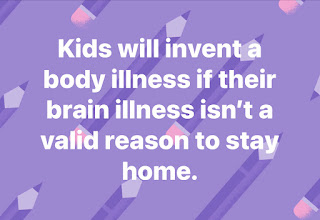
  One of my greatest frustrations in family therapy is the the fight to get kids to school. Don’t get me wrong, I think education is awesome. But it shouldn’t be used as a bludgeon to our mental health… which we need to become educated anyway. How does this happen? One reason is–ironically–the lack of education. If a kid is having an urge to not go to school, there is a REAL reason for it (one that isn’t a character flaw). Most of the time, there are serious issues going on outside of academics, such as marital conflict, bullying, friend tension, feeling misunderstood, etc. When these stressors build up, they will first make us anxious: we enter Fight/Flight brain, where logic and learning capacity decrease, and we enter “survival mode” when we do just enough to get by with the bare minimum. This is a hard state to go to school in, but it’s manageable. *And, even if it is just about not feeling prepared for a test, seeing a crush, or avoiding friend drama, there are VALID emotions...

How to Put Your Kids in Residential Treatment… Sort of…

Image
  How to Put Your Kids in Residential Treatment… Sort of… How could sending your kids away actually help them? Interesting question. In the short-term, kids tend to experience significant changes while at Residential Treatment Centers (RTCs). They can move from total mental and emotional dysfunction to thriving in 8-12 months in such an environment. Unfortunately, the long-term prognosis isn’t so great. Children often revert back to old symptoms after they return to old environments. They are likely to retain some gains from residential, but not all. This shows that people’s symptoms arise in strong relation to their environment. What is it about RTCs then? RTCs aim to apply the basic principles of human development, and generally have better resources to do so than many families. First and foremost, they seek to do no harm. The most direct way to induce anxiety, anger, and depression is to use inherently harmful actions or words. Corporal punishment is illegal in most residential ...

STEPS: Therapeutic Interaction Model

Image
For an updated and expanded version of the model, visit this link to the 20-page booklet:  https://boonechristianson.blogspot.com/2022/08/steps-booklet.html?m=1 And the 5 minute video version:  https://youtu.be/T7l7D1ukw0c STEPS:Therapeutic Interaction Model You don’t know what to do when your partner or child has a reaction that seems totally disproportional to the situation. When you try to be rational, the person becomes LESS rational, and a fight breaks out. The goal in any healthy relationship is to create mutual happiness. We can do this by showing love, THEN, if necessary, helping people change their thinking and behavior, not vice-versa. We do not show love by making them change. We could try to force changes in behavior through coercion, shaming, or fear, but this undermines the ultimate goal, and doesn't create lasting change anyway. So, our priority is to help someone feel safe, NOT to teach, challenge, critique, fix, or get a certain behavior. If you feel safe, you...