Posts

On Weight-Loss

  On Weight-Loss Full disclosure: I have never in my life had a need or desire to lose weight, not even on the wrestling team. However, I do know about the psychological mechanisms that keep us from fulfilling our goals. Since this goal is so popular, I’m taking license to give some thoughts about a few different impediments to weight loss. 1. What have you noticed about the people that successfully lose weight, keep it off, and aren’t anxiously avoiding weight gain? You may notice that, to them, it's not a big deal . And because they aren’t stressing all the time about their calorie count and exercise time, we HATE them for losing weight so easily. Let’s cool our jets for a sec and look closer at the “not a big deal” part of it. Why aren’t they stressing about losing weight? I would argue it’s because they don’t need to. They love and accept themselves how they are, so there is little stress to change. When the journey to change your physical health and appearance is for extra cr...
Why Am I Anxious, Depressed , or Angry?: The Brain and the Bucket

Image
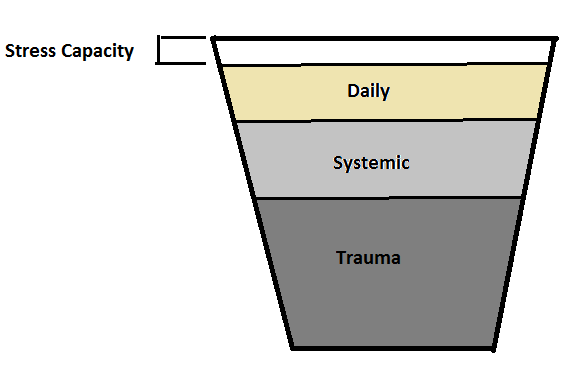
  The Brain and The Bucket: Why Am I Anxious or Depressed? 5 min video version: https://youtu.be/K_v9r_AP_Qg Many of you have seen me draw these diagrams in session to help you understand the environmental sources of maladaptive emotions (obviously this is a gross simplification of brain science, but the concept can be helpful). I work from the assumption that all emotions come from REAL sources, and that we don't generate feelings, thoughts, or beliefs that can’t be tracked to some real experience. Babies are not born to dislike themselves, have social anxiety, go numb, be addicted, or to attack people--these are conditioned into their brains. They might be born with a disposition to these conditions (e.g., a reactive amygdala), but mental illness must still be preceded by some kind of stress buildup in most cases. First, the Stress Bucket. We become anxious or angry when the bucket approaches capacity. It is filled with stressors of 3 kinds: -Trauma: This is our baggage, or sludg...

To the Parents of Adopted, Foster, or otherwise Traumatized Children

  To the Parents of Adopted, Foster, or otherwise Traumatized Children Whether or not you have chosen to have custody of a traumatized child, you have an extremely formidable challenge ahead of you, one not all parents face. There is no greater calling than parenting, and those who must parent traumatized children should be honored and supported. Thank you for your efforts. If a child is adopted or placed in the foster system, it is almost guaranteed that their brain wiring has adapted to face a world of danger. The birth mothers of these children were almost certainly under tremendous stress, increasing potential prenatal exposure to stress hormones. If the child lived in the home before being fostered, they were likely exposed to intense traumas. Even children who witness alcoholic parents come home and scream at each other every night might not be placed in foster care; the trauma must exceed legal bounds to include illegal drug use, neglect, or physical or sexual violence. Adop...

The Wholehearted Parenting Manifesto, by Brene Brown

  The Wholehearted Parenting Manifesto Above all else, I want you to know that you are loved and lovable. You will learn this from my words and actions--the lessons on love are in how I treat you and how I treat myself. I want you to engage with the world from a place of worthiness. You will learn that you are worthy of love, belonging, and joy every time you see me practice self-compassion and embrace my own imperfections. We will practice courage in our family by showing up, letting ourselves be seen, and honoring vulnerability. We will share our stories of struggle and strength. There will always be room in our home for both. We will teach you compassion by practicing compassion with ourselves first; then with each other. We will set and respect boundaries; we will honor hard work, hope, and perseverance. Rest and play will be family values, as well as family practices. You will learn accountability and respect by watching me make mistakes and make amends, and by watching how I ...

Proper Apologies

Proper Apologies  Apologies are a great way to increase positive communication and help begin healing from past confrontations. You have nothing to lose by apologizing for something from years past that you hope your loved one forgot about (Except for those with anxiety-related apologies, follow your therapist’s advice or feedback from others on how your apologies sound). Dr. Harriet Lerner, PhD, is an expert on apologies. Here are her suggestions:   -A true apology does not include the word “but” (“I’m sorry, but …”). “But” automatically cancels out an apology, and nearly always introduces a criticism or excuse.   -A true apology keeps the focus on your actions—and not on the other person’s response. For example, “I’m sorry that you felt hurt by what I said at the party last night,” is not an apology. Try instead, “I’m sorry about what I said at the party last night. It was insensitive and uncalled for.” Own your behavior and apologize for it, period.   -A true apol...

R. My Favorite Books, Videos, and Other Helps

  Books Trauma: WHAT HAPPENED TO YOU? by Scott Perry and Oprah GETTING PAST YOUR PAST by Francine Shapiro WAKING THE TIGER by Peter Levine THE BODY KEEPS THE SCORE,  by Bessel van der Kolk. An easy read on the lasting effects of trauma. Communication Skills: STOP WALKING ON EGGSHELLS, by Paul Mason and Randi Kreger. This book tells you how to deal with those with Borderline Personality Disorder, but it can help with anyone with strong emotions that are hard to validate and seem manipulative (toddlers, teens, moody spouses).  WHEN I SAY NO, I FEEL GUILTY, by Manuel Smith . A great book about skills to use to avoid being manipulated, how to set boundaries, and not feel responsible for others' feelings. HOLD ME TIGHT,  Sue Johnson, a lay-person's guide to emotion-focused couple therapy. Very good at helping structure conversations and explaining that NO ONE is the BAD GUY. Parenting: UNCONDITIONAL PARENTING,  by Alfie Kohn. A great book that questions traditional p...

R. For the Anxious, Nervous, and Insecure: The Bill of Assertive Rights

 “A BILL OF ASSERTIVE RIGHTS" by Dr. Manuel J. Smith I: You have the right to judge your own behavior, thoughts, and emotions, and to take the responsibility for their initiation and consequences upon yourself. II: You have the right to offer no reasons or excuses for justifying your behavior. III: You have the right to judge if you are responsible for finding solutions to other people’s problems. IV: You have the right to change your mind. V: You have the right to make mistakes—and be responsible for them. VI: You have the right to say, “I don’t know.” VII: You have the right to be independent of the goodwill of others before coping with them. VIII: You have the right to be illogical in making decisions. IX: You have the right to say, “I don’t understand.” X: You have the right to say, “I don’t care.” YOU HAVE THE RIGHT TO SAY NO, WITHOUT FEELING GUILTY” Found in When I Say No, I Feel Guilty, by Manuel J. Smith https://www.google.com/books/edition/When_I_Say_No_I_Feel_Guilty/cCRC...