Posts

Self-Worth: Paper Dolls, and the Concept of “Adoption”

Image
  Self-Worth: Paper Dolls, and the Concept of “Adoption” Where does your worth come from? How do you feel validated? A sense of fulfillment? A sense of importance? Your sources of self-worth can be used to explain your thoughts, feelings, and behaviors. “Belonging and Love” is the 3rd level on Maslow’s hierarchy of needs, but the need to be valued can outweigh all other basic needs. The need for validation can drive people to die from eating disorders, make them stay in physically abusive relationships, and to take their own lives.  Validation trumps physiological needs. So, we need to make sure we have our basic need of validation coming from reliable sources, at least as much as we need reliable shelter and consistent sources of food and water. The Paper Doll is a model we can use to visualize how validation is needed for a sense of security. The following model shows a person who draws the majority of their worth from a stable family environment–parents that often showed un...

Why Kids Blame Themselves

Why Kids Blame Themselves “Catastrophic thinking” is a common symptom in adult anxiety. However, it is a common occurrence in even the healthiest of young children. Luckily, many kids are able to discuss their catastrophic thoughts with validating adults so they don’t persist and become symptoms of later anxiety. One of the most common kinds of catastrophic thinking involves evaluations of the self, or attributing bad outcomes to the self: “It’s all my fault!” “I’m a bad person.” “I can’t do anything right, I’m a screw-up.” “I’m not smart.” “Nobody likes me.” Babies are not born with these thoughts. They must get instilled through experience. They exist for a reason. Children are sent these messages either directly, or they get interpreted indirectly from the environment around them. Messages coming from family members are especially sticky. Children are impressionable and tend to accept messages from those close to them as truth. If Dad tells me I’m a screw-up, it must be true. Unless...

Levels of Coping

Image
  Levels of Coping What can I do about my problem? There are many answers, but I’ve found that the ways to address our problems generally fit into 6 categories: Level 0: Numb-ers . (See “Coping vs Numbing”) These kinds of solutions may relieve or deflect the pain somewhat, but ultimately end up contributing to your problems. All kinds of addictions fall into this category, as well as other destructive habits like: -cutting yourself (and other self-harm) -getting multiple piercings or tattoos to gain a sense of control -engaging in risky/impulsive sexual behavior to feel autonomous or induce a dopamine rush -bingeing (food, tv, sex, thrills) -pornography -procrastinating -compulsive shopping -fighting -hoarding -oversleeping* It is understandable why someone feeling intense emotions could use these to cope with the pain. They give the benefit of staving off extreme anxiety, anger, or despair, which may be necessary for short-term survival. These may prevent suicidality, panic, or ps...

Did I Cause Your Outcomes?

Image
  Did I Cause Your Outcomes? As we learned from “Did I Cause Your Feelings?”, it is both possible to contribute to someone’s feelings, and not be responsible for them. The same goes for someone’s actions or outcomes. For example, you might punch someone, which leads them to punch you. If you hadn’t punched first, they likely would not have punched back; we can say you caused a fight. However, we CANNOT say that you are responsible for your adversary’s decision to punch you. They were not forced to fight back, and have the ability to choose their own actions. The same goes for outcomes, such as ending up in jail, developing mental illness, getting divorced, etc. Kids with parents who are divorced, mentally ill, incarcerated, or emotionally distant are at greater risk of having similar circumstances. But are parents responsible for these outcomes? I use the term “responsible” to mean that the parents should be blamed, they should feel ashamed, and their value as a parent should be ev...

For Parents Starting Therapy

  For Parents Dear Parents, Welcome to Family Therapy. I applaud you for reaching out for help. Though we all know it takes a village to raise a child, it’s hard to admit personally that we can’t do it on our own. Parenting is the world’s most admirable calling--one with arguably the strongest influence on the outcome of a person’s life. This is a high risk/high reward venture, and it is incredibly courageous of you to be a part of it. In therapy, we work from the assumption that you are doing your very best with the knowledge and resources you have. We assume that you love your children unconditionally (even if you don’t like them sometimes). At no point should your love or intentions be called into question. If you feel they are, please confront me about it. We are not here to judge you or your parenting. We are here to increase the knowledge and resources you have to help you get better results with your children. There are no perfect parents. We all make mistakes, AND there is ...

Relational Trauma: "Forgiveness" and "Resolution"

Relational Trauma: "Forgiveness" and "Resolution" We often encounter an issue in relationships where one person has hurt the other either deliberately or accidentally, repairs and apologies have been made, and the offended person says they have forgiven. Yet, they still have emotional reactions when events remind them of the offense. EXAMPLE: A husband reveals a pornography habit several years into a couple’s marriage, and the wife is devastated. The couple survives the revelation and the husband goes sober. The wife says she has forgiven him for using porn and hiding it.  After a year of sobriety, the wife notices her husband is spending a bit too long in the bathroom and becomes anxious. He comes out and she aggressively demands what he was doing in there. He feels hurt and defensive, accusing her of lying about having forgiven him, and a fight ensues. Turns out he was just constipated. Has she actually forgiven? I would say yes. Has her amygdala been rewired to n...

On Weight-Loss

  On Weight-Loss Full disclosure: I have never in my life had a need or desire to lose weight, not even on the wrestling team. However, I do know about the psychological mechanisms that keep us from fulfilling our goals. Since this goal is so popular, I’m taking license to give some thoughts about a few different impediments to weight loss. 1. What have you noticed about the people that successfully lose weight, keep it off, and aren’t anxiously avoiding weight gain? You may notice that, to them, it's not a big deal . And because they aren’t stressing all the time about their calorie count and exercise time, we HATE them for losing weight so easily. Let’s cool our jets for a sec and look closer at the “not a big deal” part of it. Why aren’t they stressing about losing weight? I would argue it’s because they don’t need to. They love and accept themselves how they are, so there is little stress to change. When the journey to change your physical health and appearance is for extra cr...

Why Am I Anxious, Depressed , or Angry?: The Brain and the Bucket

Image
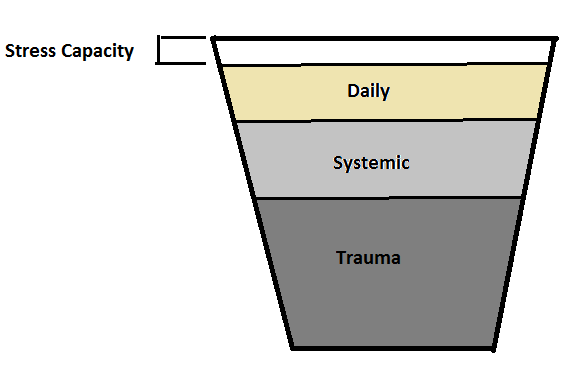
  The Brain and The Bucket: Why Am I Anxious or Depressed? 5 min video version: https://youtu.be/K_v9r_AP_Qg Many of you have seen me draw these diagrams in session to help you understand the environmental sources of maladaptive emotions (obviously this is a gross simplification of brain science, but the concept can be helpful). I work from the assumption that all emotions come from REAL sources, and that we don't generate feelings, thoughts, or beliefs that can’t be tracked to some real experience. Babies are not born to dislike themselves, have social anxiety, go numb, be addicted, or to attack people--these are conditioned into their brains. They might be born with a disposition to these conditions (e.g., a reactive amygdala), but mental illness must still be preceded by some kind of stress buildup in most cases. First, the Stress Bucket. We become anxious or angry when the bucket approaches capacity. It is filled with stressors of 3 kinds: -Trauma: This is our baggage, or sludg...